


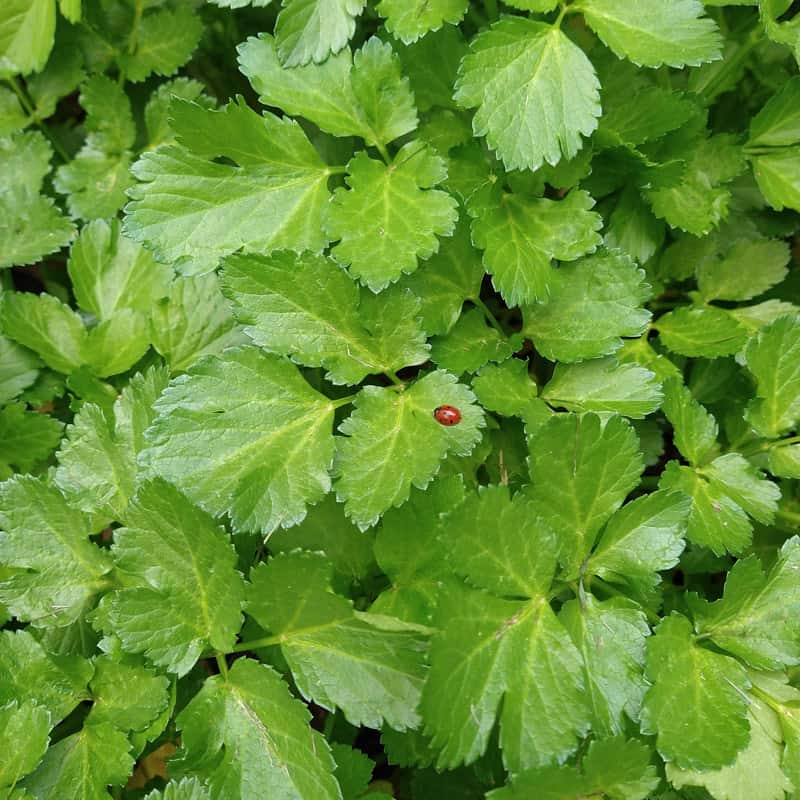
Alexanders (Organic)
Smyrnium olusatrum. Biennial.
This plant goes by many names and has a long history, possibly going back to Alexander the Great. Ancient Romans ate the leaves, stems, roots, and flower buds as vegetables. Leaves are comparable to a mild-flavored parsley, and are tasty in salad or used as an herb. Large umbels of yellow-flowered blossoms are highly desirable to beneficial insects. Aromatic black seeds give Alexanders one of its synonyms – Black Lovage. It is technically a biennial, however Alexanders may take 2-3 years to flower in some growing conditions. While it prefers part shade, it can grow in sun or shade. Self-sowing habit is perfect for low maintenance or semi-wild gardens. Native to the Mediterranean, the Romans introduced Alexanders throughout Europe, where it can still be found growing wild near medieval monastery gardens.
Seeds germinate according to their own schedule and require a period of moist, cold conditions for germination to occur. Performs best when sown in the fall or early spring. Very winter hardy. Plants sometimes go dormant in the summer heat. We thank Dr. Alan Kapuler of Peace Seeds for introducing this cool plant to the Oregon gardening scene. Aka, Alexander’s Greens, Alisanders, Black Lovage, Horse Parsley, Macedonian Parsley, and Maceron.
Alexanders seed is known to have high dormancy and benefits from cold stratification to germinate. Total Viability is printed on the seed packet and includes the germination percentage plus the dormant seed percentage as determined by an independent laboratory. Dormant seed is the portion of a seed sample that does not germinate during the short time period of the seed test, but is determined to be alive and respiring. Dormant seed is likely to germinate with cold stratification and/or longer germination times.


Best direct sown in fall for germination through the following spring. If sown in pots for transplant, sow in fall or early spring. Germination can be slow and erratic and is greatly improved by cold stratification. Great choice for winter gardens in our region. Grows in sun or part shade. Self-sowing if allowed to set seed and shatter.
Seed Saving
Collect seeds when seeds are black and dry, thresh by hand or by dancing, winnow to clean. Isolation for cross-pollination is not a concern for Alexanders.
What others are saying
There are no contributions yet.